THE AIRLINE PILOTS FORUM & RESOURCE
Good and Adverse Effects of Stress |
| by Surgeon C J Stoot (Royal Navy) -- Source: PIA Air Safety Publication |
 |
Introduction
Let's be honest, there is a lot of nonsense talked about stress these days and the subject needs to be kept in perspective. We all work for a military organization and much of what we do and are training to do is to function effectively in high stress environments. That is what going to war is all about, is it not? This article will examine how and why stress may be good for you and how it may have an adverse effect.
What is Stress?
There are as many definitions of stress as there are causes. Most people think of stress in the negative sense, automatically assuming that it is a "bad" thing. Stress may be physical or mental / psychological. On the physical side it may be due to such things as acceleration, heat / cold, vibration, etc. These will not be discussed in this article. On the mental / psychological side it could be anything from problems at work to problems at home. A useful working definition is this:
The way in which psychological or environmental factors
threaten an individual's physical or psychological state of well being
Why Do We Need Stress?
There are two reasons why we need stress. The first is that unless we have some stress, we do not function as effectively as we would otherwise, i.e. some stress is good for us. For many of you who have done aviation medicine training, this will be familiar. It is represented by what is called the Yerkes-Dodson curve:
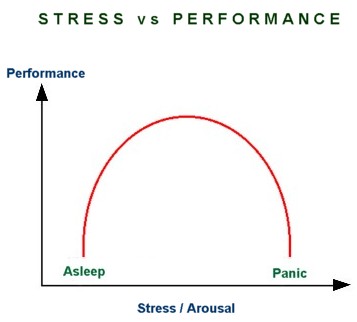
As you can see from the diagram, at low stress levels we are, if not asleep, at a low alert state and our performance and operating efficiency is equally low. As stress levels increase so does our performance until we reach peak efficiency. From then on, however, it is downhill until we reach the stage of panic where we have confused thought and cannot operate properly. Therefore, the right amount of stress is good; too much or too little most probably not being a good thing.
Of course where we are on the graph will depend on many factors, e.g. character, past experiences, the nature of the stress concerned, training and experience. And it is the latter which must be an important consideration in training.
Therefore, the second reason is that unless training is able to achieve its aim, i.e. to train us for what we are supposed to do (which we may consider to be functioning effectively in high stress environments), then it has failed. Hence, by definition we must achieve high stress levels during training. How else could we ever be prepared for active operations?
So there, in a nutshell, are some reasons why stress is "good for us" - but of course it is not all good news. You only have to ask any PMO and he will tell you that his department has a number of what might be termed "stress cases" every year. Many cases do not even reach the sickbay; it is not always appropriate.
Dosage
There is a dosage of stress, both short and long-term, with which we are able to cope. This dosage is related to the type of stress as well as the amount. The dosage is individual or personal. The amount of stress which we are able to cope with will depend on many factors including an individual's personality, past experiences including training, expectations, personal circumstances etc.
All of us are able to exceed this dosage for short periods without there being any adverse effects. However, if the dosage is acute and extreme we will not cope and this is when panic occurs. If the stress is longer term then the signs and symptoms may develop further.
It is also important to realize that one cannot separate what stresses there are at home with what there are at work. They all contribute to the same dosage.
The Adverse Effects of Stress
Factors causing stress are:
Work Factors:
Demands: These may be derived from things like high workload, too much responsibility short deadlines and interpersonal demands - from bosses, colleagues and subordinates. Whilst we do concentrate on, say, excessive levels of work, don't forget that too little to do can be equally as stressful. Whilst it may at times sound attractive, boredom is a dangerous thing!
Supports: Even if we are having a difficult time from one direction, our overall dosage can be reduced by support from other areas. For instance, if workload and deadline demands are high but your peer colleagues and subordinates are supportive, this support can go a long way to minimizing the effects of the stress. Remember the most important factor in stress reduction: "everyone functions better and is more resistant to stress if they are part of a cohesive team". That is something the FAA does well.
Family / Social Factors:
As mentioned earlier, when it comes to stress you can never separate what goes on at home with what goes on at work. Both areas may contribute to the "overall dosage". It has certainly been the case that many patients suffering from excessive stresses at home have "presented" as cases of deteriorating flying performance.
Warning Signs or Strain Symptoms
So what are the warning signs of the stress dosage being exceeded? They may be listed as below:
Defensiveness, sensitivity to criticism.
Inappropriate aggression.
Acute or chronic interpersonal problems... at work... at home.
Financial problems which may be the result of stress or the cause of it.
Excesses in routine habits e.g. smoking, eating, drinking.
Retreat from normal social activities e.g. crew room banter.
Fatigue for no particular reason e.g. despite having a good night's sleep.
Deteriorating or poor flying performance.
Increased risk taking.
Personality changes.
In short:
If these are happening to you or those around you, you are at risk
If stress does become truly chronic, then it is possible for actual disease to develop e.g. early heart attacks, raised blood pressure, early strokes and even many cancers. Sounds pretty alarming, but just remember that the stress has to be severe and present for a long time for these to develop.
Prevention
As the saying goes, prevention is better than cure. So what can we do to minimize the potential effects of excessive stress? Nothing works better than sorting out the root cause, not always that easy. However, there is much we can do ourselves to make us more resistant to stress. Some examples are:
Stress Management
Organization - organize your life so that you avoid any unnecessary stresses and do not create any new ones by your action.
Health - those who are physically fit and in good health are far more resistant to stress. So keep fit by taking regular exercise and eat a good and balanced diet.
Relaxation - is vitally important. You need to have a form of relaxation to recover from the stresses of the day.
Laugh - Laughter is a good cure all, releasing tension caused from stress.
Spend time with friends and enjoy other people's company.
Worried?
What I do not want to do is create a problem which does not in reality exist. If you are worried in any way, though, remember that a problem shared is a problem halved. Don't keep things bottled up, doing that will only create more stress. Talk to someone, whoever you feel most at ease with... and remember, the Sickbay is always there and is prepared to help you out.